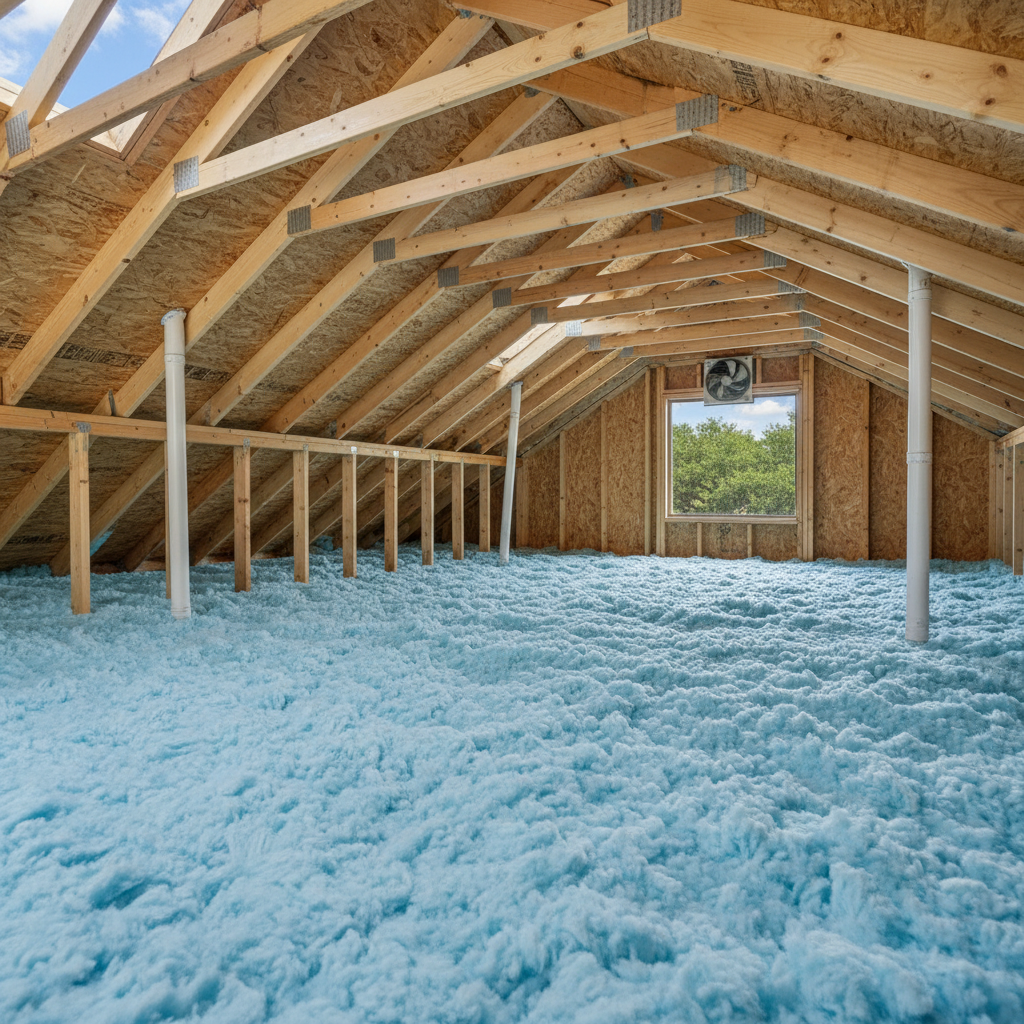
Walking into an attic in San Antonio during July feels like opening a giant oven door. That is standard for homes in San Antonio, TX, and if your attic insulation is not up to standard, your air conditioner runs continuously just to keep the house cool. San Antonio Spray Foam Insulation has inspected many attics across Alamo Heights and Stone Oak where homeowners attempted to save money on a Blown-In Insulation upgrade, only to create larger issues later. Let us review where mistakes happen so you do not waste money.
Skipping the Air Sealing Step First
The largest mistake contractors and DIYers make is blowing loose-fill insulation directly over a leaky attic floor. Blown-in fiberglass or cellulose stops radiant heat and slows down conduction, but it does not stop air movement. If your top plates, wire penetrations, and recessed lights are not sealed with caulk or expanding foam first, conditioned air from your living room will bleed straight up into the attic. San Antonio Spray Foam Insulation reminds homeowners that Blown-In Insulation is only half of the battle. Air sealing is where the real energy savings happen for homes in San Antonio, TX.
Chasing the Lowest Bid Without Checking the R-Value Math
Some unreliable contractors offer an extremely low price to top off your attic with Blown-In Insulation. They show up, blow a minimal amount of material into the space, and hand you a bill. The catch is that they are not hitting the required R-value for our scorching South Texas climate. In this region, you want at least an R-38 or R-49, which requires a specific depth depending on whether you are using cellulose or loose-fill fiberglass. If the installer cannot show you depth markers or explain the settled density, you are getting shortchanged on your Blown-In Insulation installation.
Ignoring Moisture and Roof Leaks
San Antonio weather swings wildly from bone-dry droughts to torrential downpours during tropical system blow-throughs. If your roof has a minor, undetected leak, blowing wet material over it is a major problem. Cellulose turns into a heavy, soggy mass that loses all thermal value and rots your ceiling drywall. Fiberglass handles moisture a little better, but it still packs down and loses its loft when soaked. Always fix your roof flashing and plumbing boots before any Blown-In Insulation truck pulls up to your driveway in San Antonio, TX.
Failing to Install Proper Attic Ventilation
More insulation is not always better if your attic cannot breathe. When you add a thick blanket of Blown-In Insulation, you run the risk of blocking your soffit vents if baffles are not installed properly. Without clear airflow from the eaves up to the ridge vents, your attic traps extreme heat and moisture. That trapped heat bakes your shingles from the underside, cutting your roof's lifespan in half. Make sure your contractor includes ventilation baffles in the scope of work before they start installing any Blown-In Insulation.
Completing a Blown-In Insulation project correctly means taking the time to prep the space, hiring a professional who knows local building quirks, and refusing to cut corners on depth. Take a quick look up in your attic hatch today to see what you are actually dealing with. For homes and businesses in San Antonio, San Antonio Spray Foam Insulation provides Blown-In Insulation services.